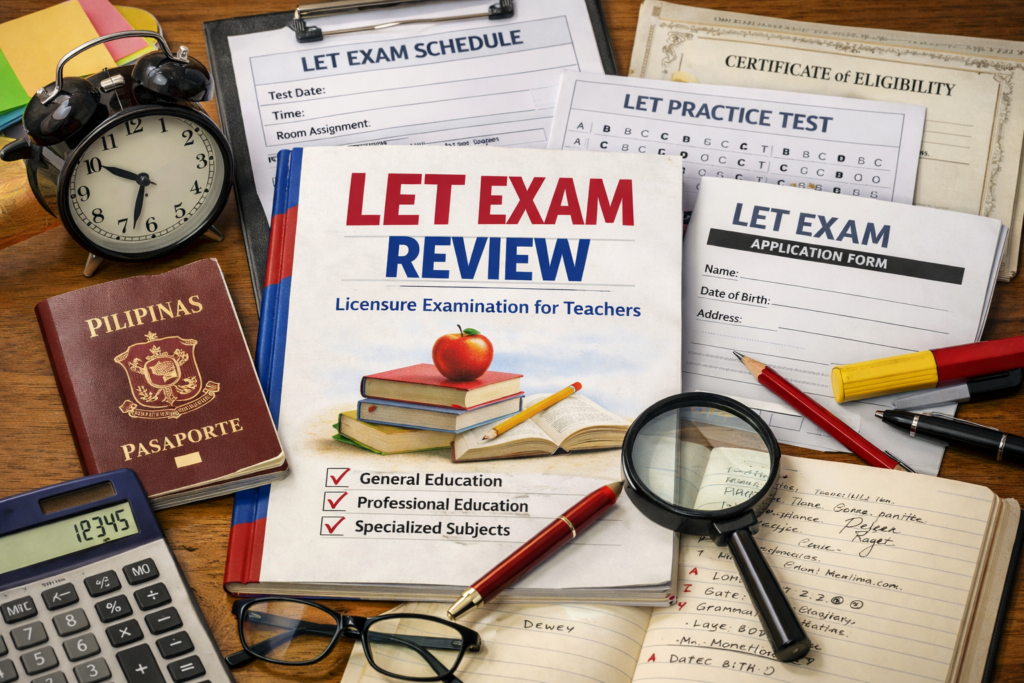
The Licensure Examination for Professional Teachers (LET) is more than just a test; it is the legal “gatekeeper” to the teaching profession in the Philippines. Without passing it, you cannot officially call yourself a “Professional Teacher” or practice in any Philippine classroom.
FAQs
Why People Should Take the LET?
Legal License to Teach: Under RA 7836, you are legally required to pass the LET to teach in both public and private schools.
Automatic Civil Service Eligibility: Passing the LET grants you RA 1080 eligibility. This means you are automatically qualified for any government position that requires a “Professional” civil service level, even outside of teaching.
DepEd Career Growth: You cannot be hired as a permanent teacher (Plantilla) or be promoted to higher ranks like Master Teacher or Principal without a valid PRC license.
Global Recognition: A Philippine teaching license is often a prerequisite or a major advantage if you plan to teach abroad (e.g., in Thailand, Vietnam, or through the JET program in Japan).
Professional Prestige: Passing the LET earns you the title of LPT (Licensed Professional Teacher), a mark of competence and dedication to the craft.
What company a LET Passer can apply?
As a Licensed Professional Teacher (LPT), your career options in 2026 are surprisingly broad. While most people think only of the Department of Education (DepEd), your license is a highly respected credential that opens doors in the corporate, tech, and international sectors.
Here are the types of companies and organizations where a LET passer can apply:
1. Government Agencies (Public Sector)
Because passing the LET gives you RA 1080 eligibility, you are qualified for almost any professional-level government job, not just teaching.
- Department of Education (DepEd): The primary employer for public school teachers (Teacher I, II, III).
- State Universities and Colleges (SUCs): You can apply as an Instructor or Registrar in public higher education institutions.
- Civil Service Positions: You can apply for non-teaching roles in any government office (e.g., DSWD, DILG, PSA) as an Administrative Officer, Clerk, or Training Specialist.
2. Corporate & Private Sector (Non-Teaching)
Many large companies in the Philippines hire LET passers for their communication skills, patience, and ability to organize information.
- BPO & Shared Services: Companies like Accenture, Cloudstaff, and Foundever hire teachers for:
- Training & Development: Teaching new employees the skills they need for their roles.
- Quality Assurance (QA): Monitoring and “grading” calls or emails for clarity.
- Human Resources (HR): Many private firms value teachers for Recruitment and Employee Onboarding roles.
- Publishing & Media: Companies like Vibal, Rex Book Store, or GMA Network hire LPTs as:
- Content Editors & Proofreaders
- Curriculum Developers
- Educational Consultants
3. Education Technology (EdTech) & Online Platforms
With the shift to hybrid learning in 2026, many LPTs now work for global tech firms that focus on education.
- ESL Platforms: Companies like 51Talk, RareJob, and EDGE Tutor hire online English teachers (WFH options).
- AI Companies: Tech firms like Innodata hire teachers as AI/LLM Evaluators to help train artificial intelligence to speak and write better.
- Review Centers: Established centers like CBRC (Carl Balita) or CEVAS hire LPTs to be instructors for future board exam takers.
4. International Opportunities
Your Philippine license is the “base” requirement for many international programs.
- Ambassador Teacher Programs: Organizations like Participate Learning recruit LPTs to teach in the United States.
- JET Programme: The Japanese government recruits LPTs as Assistant Language Teachers (ALTs) in Japan.
- International Schools: Private schools like Brent, ISM, or schools in the UAE and Thailand frequently look for licensed Filipino teachers.
Quick Comparison: Teaching vs. Non-Teaching Roles
| Industry | Common Job Title | Why LPTs are Preferred |
| DepEd | Teacher I–III | Mandatory Requirement (RA 1080) |
| Corporate | Training Associate | Expert in “Facilitating Learning” |
| EdTech | Curriculum Developer | Mastery of “Assessment of Learning” |
| BPO | Communication Trainer | High English/Filipino Proficiency |
Step by Step Application.
The application is handled by the Professional Regulation Commission (PRC). Most of the process is now done online through the LERIS (Licensure Examination and Registration Information System) portal.
Step 1: Preparation of Requirements
Before going online, ensure you have these documents ready:
- Transcript of Records (TOR): Must have a scanned picture and the specific remark: “For Board Examination Purposes Only.”
- PSA Birth Certificate: Original and photocopy.
- PSA Marriage Contract: (For married female applicants only).
- Valid ID: At least one government-issued ID (e.g., Passport, UMID, Driver’s License).
- 4 Passport-size Photos: White background, with a complete name tag (handwritten).
Step 2: Create a LERIS Account
- Visit the PRC LERIS website.
- Click “Register” and fill out your personal details exactly as they appear on your PSA Birth Certificate.
- Upload your digital ID photo (2×2 style, white background, with collar).
Step 3: Select the Examination
- Once logged in, click “Select Transaction.”
- Go to the “Examination” tab.
- Select “Professional Teacher” and choose your level (Elementary or Secondary) and your Major/Specialization.
Step 4: Schedule an Appointment
- Choose the PRC Regional Office or Satellite Office where you want to process your documents.
- Select your preferred date and time for the physical appearance.
Step 5: Pay the Application Fee
- Fee: Typically ₱900 for first-timers and ₱600 for repeaters.
- Payment Channels: You can pay via GCash, Maya, Landbank Link.Biz, or at the PRC Cashier during your appointment.
Step 6: Physical Appearance at PRC
Receive your Notice of Admission (NOA): This is your most important document—it tells you your room assignment and what to bring on exam day
Go to your chosen PRC office on your scheduled date.
Submit your printed Application Form (from LERIS) and the original/photocopies of your documents for evaluation.
Can a LET Passer apply for Higher Education Institutions?
Yes, you can certainly use your Licensure Examination for Professional Teachers (LET) status in Higher Education, but the rules for college teaching are very different from those in elementary and high school.
In Higher Education Institutions (HEIs), your LET license is often supplementary rather than the primary requirement.
1. The Minimum Requirement: Master’s Degree
Unlike basic education (DepEd), where a Bachelor’s degree + LET is the standard, the Commission on Higher Education (CHED) mandates that the minimum educational qualification for a regular college instructor is a Master’s Degree in the field of specialization.
- Regular/Permanent Faculty: You generally cannot be regularized or promoted in a university without a Master’s degree, regardless of your LET status.
- Temporary/Part-time: Some universities hire Bachelor’s degree holders as “Lecturers” or “Part-time Instructors,” but usually on the condition that they are currently enrolled in a Master’s program.
2. Where the LET Specifically Matters
There are specific departments in college where having a LET license is either mandatory or highly preferred:
- College of Education: To teach professional education subjects (like Principles of Teaching or Assessment of Learning), you must be an LPT. CHED requires these faculty members to have a license and often a Master’s in Education.
- General Education (GenEd) Subjects: If you are an LPT with a major in English, Math, or Science, you are a strong candidate to teach GenEd subjects to first- and second-year college students.
- RA 1080 Eligibility: As an LPT, you hold RA 1080 eligibility, which means you meet the civil service requirement for “Instructor” positions in State Universities and Colleges (SUCs) without needing to take the Civil Service Exam.
3. Key Differences in Requirements
| Level | Primary Requirement | Role of the LET |
| Elementary / High School | Bachelor’s Degree + LET | Mandatory by law (RA 7836). |
| Higher Education (College) | Master’s Degree | Optional (unless teaching Education subjects). |
How to Transition to College Teaching
If you are a teacher wanting to move into Higher Education, follow these steps:
- Enroll in Graduate Studies: Start your Master’s degree immediately. Most universities look for “Master’s units” even for entry-level part-time roles.
- Focus on Specialization: Your value in college depends on your Major. A Master’s degree that is “vertically aligned” with your Bachelor’s (e.g., BS Math to MS Math) is most preferred.
- Highlight RA 1080: When applying to public colleges (SUCs), clearly state your RA 1080 (Teacher) eligibility on your Personal Data Sheet (PDS).
[Professionalizing teaching in higher education Philippines]
Would you like me to help you find a list of Master’s degree programs or CHED-accredited universities in your region that offer graduate studies for teachers?
Qualifications for College Instructors in the Philippines This video provides a helpful overview of the legal and institutional requirements for teaching in the Philippines, clarifying the different standards for basic and higher education.